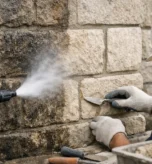
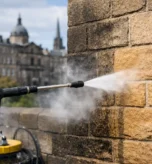
A sandstone wall rarely fails all at once. More often, the first warning is subtle – a fine open joint, a little loose material beneath a window, a damp patch that seems to linger longer after rain. For owners of period buildings, spotting the signs of failing mortar joints early can make the difference between straightforward repointing and far more extensive stone repair.
In Edinburgh’s older properties, mortar does more than fill the spaces between stones. It helps manage moisture movement, cushions slight building movement, and protects the arrises and faces of the stone itself. When mortar begins to break down, the surrounding masonry is left exposed. That is where small defects can become expensive ones.
Why mortar joints matter so much in sandstone buildings
On traditional stone buildings, especially those built with lime mortar, the joints are designed to be sacrificial. In simple terms, the mortar should weather before the stone does. That is a good thing, provided the worn mortar is replaced at the right time with a compatible material.
Problems tend to start when joints are left open for too long, or when a previous repair has used a hard cement mortar that traps moisture and places stress on softer sandstone. In exposed parts of Edinburgh – parapets, chimney stacks, boundary walls and upper elevations in particular – weathering can accelerate this process.
A careful inspection usually reveals the pattern. The key is knowing what you are looking at, and what it may be telling you.
The most common signs of failing mortar joints
1. Recessed or missing mortar
One of the clearest signs is mortar that has worn back noticeably from the face of the stone. Sound pointing should sit neatly within the joint and provide proper protection at the edges of each stone. If joints look hollowed out, uneven or partly empty, rainwater can enter more easily.
This is often first seen on the most weathered elevations, where wind-driven rain and frost exposure are greatest. A few isolated open joints may not indicate wholesale failure, but they should not be ignored, particularly around high-level masonry.
2. Cracking along the joints
Hairline cracking in mortar can appear for several reasons. Some cracks are relatively minor and linked to age, shrinkage or local weathering. Others suggest movement, inappropriate repair materials, or moisture-related deterioration.
The important point is context. Fine cracking on its own does not always mean urgent structural trouble, but stepped or repeated cracking through several joints deserves closer assessment. If cracks coincide with movement in the stonework, lintels or surrounding openings, the issue may go beyond simple repointing.
3. Loose, powdery or crumbling mortar
If the mortar can be rubbed away easily by hand, it has lost much of its integrity. Mature lime mortar does weather over time, but it should not be reducing to friable dust throughout the joint. Crumbling mortar often points to prolonged saturation, age-related decay, salt action or previous incompatible repairs nearby.
This is especially common in neglected areas where water is repeatedly entering the wall from defective gutters, flashings or copings. In those cases, repointing alone may not be enough unless the water source is also addressed.
4. Damp patches internally or externally
Failing joints are a common route for moisture ingress. On external walls, you may notice localised darkening after rainfall, staining beneath sills, or greener areas where persistent moisture encourages biological growth. Inside, the symptoms can be less direct – damp patches, salt deposits, peeling finishes or a musty smell.
Not all damp in older buildings comes from mortar failure, and diagnosis should always be careful. Condensation, defective rainwater goods and trapped moisture from impervious coatings can produce similar symptoms. Even so, open or deteriorated joints are often part of the picture in traditional stone construction.
5. Spalling or damaged stone edges
When mortar joints fail, the stone around them loses protection. Water enters the joint, sits within the masonry, and expands in freezing conditions. Over time, the stone edges can begin to break away, a process often seen as spalling, flaking or loss of sharp detail.
This is where delay becomes costly. Repointing is intended to preserve the masonry fabric. Once the stone itself has started to fail, repairs may extend to indenting, piecing-in or full stone replacement. On listed and period properties, that has obvious implications for cost, programme and heritage sensitivity.
6. Vegetation or moss growth in the joints
Small weeds, moss or other organic growth appearing directly from mortar joints are more than a cosmetic nuisance. They indicate retained moisture and open gaps where material has already deteriorated enough to allow rooting.
On boundary walls and neglected elevations, this can be quite visible. On principal façades, it may be more discreet but still significant. Vegetation also accelerates deterioration by forcing joints apart and holding moisture against the masonry.
7. Hard patch repairs standing proud of the wall
One of the less obvious signs of failing mortar joints is inconsistency. If sections of pointing are much harder, smoother or darker than the surrounding joints, the wall may have been patch repaired with an unsuitable cement-rich mortar.
That can create a false impression of soundness. The hard material may remain in place while adjacent original mortar and sandstone deteriorate around it. In practice, the strongest-looking repair is not always the most appropriate one. For traditional sandstone buildings, compatibility matters more than sheer hardness.
8. Mortar failure concentrated around chimneys, parapets and windows
Some areas are naturally more vulnerable than others. Chimneys and parapets take the full force of weather exposure. Window surrounds, cills and projecting stone details are prone to concentrated water run-off. If mortar failure is recurring in these locations, it is usually a sign that exposure and water management need to be considered alongside the pointing itself.
A localised defect may still require a wider view of the building envelope. Good repair work is not just about filling joints. It is about understanding why that section failed first.
What causes mortar joints to fail?
Age and weathering are the obvious factors, but they are not the only ones. Edinburgh’s sandstone tenements, villas and boundary walls are exposed to cycles of driving rain, frost and drying, and mortar will not last indefinitely. Yet premature failure often comes back to inappropriate materials or deferred maintenance.
Hard cement pointing is a frequent issue on older buildings. It can prevent the wall from breathing as intended and force moisture into the stone rather than allowing it to evaporate through the joint. Over time, that may lead to accelerated stone decay, trapped damp and uneven weathering.
Poor workmanship can also shorten the life of the repair. Joints that are not properly prepared, incorrectly gauged mortars, or pointing applied in unsuitable conditions can all fail earlier than they should. Equally, if defective gutters, downpipes or flashings are left unresolved, even a well-executed repair may struggle.
When repointing is enough – and when it is not
This depends on the condition of the surrounding masonry. If the stone remains sound and the joints have simply weathered back, specialist repointing with an appropriate lime mortar is often the right solution. Done properly, this restores weather resistance while maintaining breathability and visual consistency.
If the stone arrises have broken down, faces are delaminating, or previous cement repairs have caused wider damage, more comprehensive masonry restoration may be needed. That can include stone indents, localised replacement, crack repair and careful removal of unsuitable historic pointing.
The right approach is always led by the building. A listed townhouse in the New Town, for example, requires a different level of care and finish from a modern wall built with entirely different materials. The principle remains the same, though: repair should protect the masonry for the long term, not simply tidy the surface.
Why early inspection saves both stone and cost
Mortar joint failure is one of those problems that rewards early action. Repointing is typically far less disruptive and less expensive than dealing with widespread moisture ingress or decayed sandstone later on. It also helps preserve more of the original fabric, which matters on historic buildings where authenticity and detail are part of the property’s value.
A professional inspection should look beyond the joint itself. Exposure, stone condition, previous repairs, moisture paths and the suitability of existing mortar all need to be considered together. That is particularly important in Edinburgh, where traditional sandstone buildings vary in age, condition and past intervention.
At A & M Sandstone Restoration Edinburgh, that assessment-led approach is central to good repair. The aim is not cosmetic patchwork. It is careful, compatible restoration that respects the building and addresses the actual cause of deterioration.
If you have noticed open joints, crumbling mortar or damp appearing around stonework, it is worth having the masonry checked before the next winter does the checking for you.