A darkened elevation, open mortar joints or flakes of stone beneath a window can all prompt the same question: does the building need sandstone restoration versus facade refurbishment? The terms are often used interchangeably, but they describe different approaches. Choosing the right one affects not only how a property looks from the street, but how well its original stone fabric performs through Edinburgh’s rain, frost and changing seasons.
For period and listed buildings, the distinction matters. A facade may need careful local repair and protection rather than a broad cosmetic scheme. Equally, widespread decay can mean that treating one or two visible defects is not enough. A sound decision starts with understanding the building’s condition, materials and cause of deterioration.
What sandstone restoration means
Sandstone restoration is a conservation-led process focused on retaining and repairing original stone wherever it remains sound. The objective is not to make an old building look newly built. It is to stabilise deteriorated areas, address moisture pathways and preserve the character, texture and detailing that give a period property its value.
A specialist stonemason begins by assessing the condition of the stone and surrounding mortar. Sandstone can weather unevenly: sheltered sections may remain firm while exposed cornices, parapets, window cills and projecting mouldings become friable. Cracking, delamination, spalling and erosion are recorded alongside issues such as failed rainwater goods or hard cement pointing, which may be contributing to the damage.
Repairs are then designed to be proportionate. Loose or decayed material is carefully removed back to a sound substrate. Smaller losses may be rebuilt with a compatible mineral repair mortar, shaped and finished to match the surrounding profile. Where the face of the stone has failed more deeply, an indent repair can be formed from carefully selected matching sandstone. A whole stone replacement is reserved for areas where repair would not provide a stable or durable result.
Lime pointing is central to many sandstone restoration projects. Traditional sandstone walls were designed to work with breathable lime mortar. Lime joints accommodate slight movement and allow moisture to evaporate through the mortar rather than forcing it through the stone face. Repointing with an overly hard, impermeable cement mortar can trap moisture and accelerate spalling at the edges of the stone.
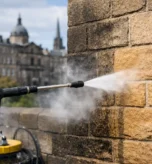
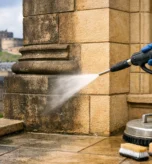
Cleaning may also form part of restoration, but it is not automatically the answer to a tired-looking facade. Gentle, controlled methods can remove certain soiling, staining or biological growth. Aggressive cleaning, however, can strip the protective weathered surface of softer sandstone and leave it more vulnerable. The right method is determined by test areas and the condition of the stone, not by the desire for an instant uniform colour.
What facade refurbishment usually covers
Facade refurbishment is a broader term. It describes planned works to improve, repair or renew the exterior face of a building. On an Edinburgh tenement, townhouse or commercial property, this may include stone repairs, repointing and cleaning, but it can also cover window refurbishment, render repairs, roofline work, rainwater goods, coatings and decorative elements.
The purpose is often wider than conserving masonry alone. A refurbishment scheme might respond to multiple defects across an elevation, improve weather tightness, meet maintenance obligations or prepare a property for sale, letting or a change in use. It may involve access scaffolding, phased work across several flats or coordination with factors, surveyors and other trades.
That broader scope can be appropriate where the whole facade has been neglected, where water is entering at several points, or where different materials are failing together. A defective cast-iron downpipe, for example, may be the cause of staining and stone saturation below it. Repairing the sandstone without correcting the drainage issue would only treat the symptom.
However, facade refurbishment should not become a reason to replace historic fabric unnecessarily. On a fine ashlar facade in New Town, Stockbridge or The Grange, wholesale removal of weathered but stable stone can diminish original detail and create an obvious visual mismatch. A good refurbishment specification still follows preservation-first principles: retain what is sound, repair what can be repaired, and replace only what has genuinely failed.
Sandstone restoration versus facade refurbishment: the practical difference
The simplest distinction is one of focus and scale. Sandstone restoration focuses on the stone fabric and uses conservation methods to extend its life. Facade refurbishment considers the elevation as a whole and may combine masonry restoration with several other building repairs.
In practice, the two often overlap. A facade refurbishment project can include substantial sandstone restoration, while a carefully planned restoration may reveal the need for limited work to flashings, windows or drainage. The important question is not which label sounds more comprehensive. It is which scope deals with the source of deterioration without sacrificing sound historic material.
A localised problem often calls for restoration. Typical examples include a few spalled stones beneath leaking gutters, failed lime joints on an exposed gable, or damaged mouldings around a bay window. Once the cause of water ingress has been resolved, targeted repairs can preserve the rest of the elevation and avoid needless disruption.
A wider refurbishment may be the better route when defects are repeated across the facade. Extensive open joints, widespread failed previous repairs, several cracked lintels, defective rainwater goods and poor condition around windows point to a connected maintenance problem. In these cases, a planned programme can produce a more consistent and durable result than isolated call-outs over several years.
Why diagnosis must come before a specification
Sandstone is not a uniform material. Edinburgh buildings contain stone from different sources, with variations in colour, grain, porosity and durability. The same elevation can also experience dramatically different weathering depending on orientation, height, shelter and exposure to wind-driven rain.
For that reason, visible damage should never be judged in isolation. A crack may be a superficial fracture in a weathered stone face, or it may indicate movement around an opening. Powdering can result from natural decay, but it may also be worsened by saturated masonry, salt contamination or incompatible repairs. Stone that looks dark is not necessarily dirty; it may be damp.
A proper inspection considers the mortar, stone, joints, details and water management together. It identifies whether a repair is cosmetic, functional or structural, and whether consent may be required. Listed buildings and properties in conservation areas can have additional requirements, particularly where original features or appearance will be altered. Early professional advice helps owners plan appropriate work rather than discovering constraints after scaffolding is in place.
Materials and workmanship determine the outcome
The long-term quality of either approach depends on compatibility. New stone should be selected to complement the existing fabric in appearance and physical behaviour, not simply chosen because it is available. Repair mortars need suitable strength, permeability and texture. Lime pointing should be properly prepared, placed in suitable conditions and finished to suit the original joint profile.
Details matter just as much as materials. An indent must be set back and bonded correctly. A replacement cill needs an effective drip and fall to shed water. Pointing must be carefully raked out without damaging stone arrises, then packed into clean joints rather than applied as a thin surface smear. These are not finishing touches. They are the difference between a repair that ages naturally and one that fails prematurely.
Poor work can create a misleading short-term improvement. Heavy cement pointing, dense patch repairs and indiscriminate coating may conceal defects briefly while restricting the wall’s ability to manage moisture. When deterioration reappears, the original sandstone may be in worse condition and the eventual repair more costly.
Planning the right scope for your property
Cost should be considered in relation to scope, access and longevity rather than as a simple price per stone. Local repairs can be economical where defects are confined, but high-level access may still be needed. Larger facade refurbishment projects require more coordination and may cost more initially, yet they can address linked defects in one programme and reduce repeat access costs.
The clearest route is a condition-led specification. It should explain what is being repaired, why that repair is appropriate, which materials will be used and how adjacent causes of decay will be addressed. Photographs, marked-up elevations and clear allowances for hidden deterioration make expectations more realistic for homeowners, landlords and property managers.
A & M Sandstone Restoration Edinburgh approaches period masonry with this balance in mind: careful investigation, traditional craftsmanship and repairs intended to protect the building for the long term. If your sandstone is showing signs of decay, arranging a specialist assessment before committing to a broad refurbishment can help ensure the work respects both the facade and the history held within it.