A small crack beneath a window, crumbling mortar at a chimney, or flakes lifting from a sandstone sill can appear to be a straightforward repair. On an Edinburgh period property, however, each may be evidence of a wider moisture or material-compatibility problem. Choosing the right stonemason for your Edinburgh property is therefore about far more than finding someone who can fill a gap in stone. It is about appointing a specialist who understands how the building was made, how it has weathered, and how to preserve it without creating further damage.
Edinburgh’s sandstone buildings have survived generations of wind, rain, pollution and alteration. Their character depends on the relationship between stone, mortar, detailing and moisture movement. A repair should protect that relationship, not simply make the façade look tidier for the moment.
Why specialist stonemasonry matters in Edinburgh
Traditional sandstone construction is designed to breathe. Moisture that enters through exposed masonry or open joints should be able to evaporate again through suitably porous stone and lime mortar. Problems often arise when later repairs introduce hard cement mortar, impermeable coatings or an unsuitable stone patch. These materials can trap moisture and force it through the softer surrounding sandstone, accelerating erosion, cracking and spalling.
This is particularly relevant to properties in areas such as the New Town, Stockbridge, Morningside, Bruntsfield and The Grange, where original stonework is a major part of both the building’s value and its architectural identity. The same principle applies to tenements, villas, boundary walls and commercial buildings across the city.
A general builder may be capable of undertaking minor masonry work, but specialist knowledge becomes essential where original sandstone is deteriorating, mortar joints are failing, or there are signs of damp penetration. The right stonemason will diagnose the cause before proposing the repair. That distinction can prevent a cosmetic job from becoming an expensive cycle of repeat work.
Choosing the right stonemason for your Edinburgh property
The strongest starting point is evidence of relevant experience. Ask whether the contractor regularly works on sandstone and period buildings, rather than treating stone repairs as an occasional add-on. Their portfolio and explanation of the proposed work should show familiarity with lime pointing, indents, stone replacement, crack repair and careful mortar removal.
A good survey is not rushed. The stonemason should inspect the condition of the masonry, look for likely sources of water ingress, assess the state of existing pointing and identify whether deterioration is localised or part of a wider issue. For example, a spalled stone at low level may be related to splashback, leaking rainwater goods or unsuitable cement pointing above it. Replacing the face of the stone without resolving the cause will only postpone the problem.
You should also expect plain, specific answers. What will be removed? How will adjacent stone be protected? Which mortar will be used? Will the repair match the existing stone in colour, texture and density? A contractor who can explain these decisions clearly is far more reassuring than one who offers only a broad promise to ‘repair the wall’.
Look for lime mortar knowledge, not just repointing experience
Pointing is one of the most visible parts of a sandstone restoration project, yet it is frequently done poorly. Old joints need to be raked out to an appropriate depth without damaging the arrises, or sharp edges, of the surrounding stone. The replacement mortar must then be selected and finished to suit the masonry.
Lime mortar is generally more flexible and vapour-permeable than cement-based alternatives. It allows a traditional wall to manage moisture in the way it was intended to. The precise mix, aggregate and finish depend on the building, its exposure and the original mortar. A very hard or overly neat-looking joint can be a warning sign on a historic façade.
Ask the contractor how they decide on the mortar specification and finish. They should discuss compatibility, weather exposure and the appearance of the existing work, rather than automatically applying one mix to every property.
Assess their approach to stone repair and replacement
Not every damaged stone needs to be fully replaced. A skilled stonemason may be able to carry out a carefully formed indent repair where deterioration is confined to one area. This preserves more of the original building fabric and can be less disruptive than removing the entire stone.
Where replacement is necessary, stone selection is crucial. The new piece should be compatible in geological character, colour, porosity and durability, while also being worked to match the original profile and tooling. A poorly matched replacement may stand out immediately or weather at a different rate from the masonry around it.
There are occasions when a repair mortar is appropriate for shallow, stable defects, and others when it merely disguises a deeper failure. An experienced specialist will explain that trade-off honestly. The least invasive repair is often desirable, but it must still be durable and technically sound.
Questions worth asking before you appoint anyone
A detailed written quotation is a sign of professional preparation. It should describe the areas to be repaired, the proposed methods, materials, access arrangements and any assumptions made during the survey. It does not need to be filled with jargon, but it should be clear enough that you know what is and is not included.
During your discussion, ask how the stonemason will manage dust, protect windows and landscaping, and keep the site safe if scaffolding is required. For occupied homes and tenement properties, considerate working arrangements matter just as much as workmanship. If the job affects a shared elevation, it is also sensible to establish responsibility for access, neighbour communication and approvals before work begins.
For listed buildings or properties in conservation areas, proposed alterations may require consent where they affect the character of the building. A knowledgeable local stonemason will recognise when this needs to be considered, although the property owner should always confirm the relevant requirements before work starts.
It is reasonable to request examples of comparable completed projects and to ask who will carry out the work on site. Be cautious if the survey is undertaken by one person but the masonry is passed to an unfamiliar subcontractor without clear oversight. Stone restoration relies heavily on the judgement and hand skills of the people doing the work.
Avoid repairs that solve appearance but worsen the wall
The lowest quotation is not always the best value. A low figure can reflect reduced preparation, inadequate access, generic materials or an assumption that only the most obvious defects need attention. Those shortcuts are particularly risky with historic sandstone.
Watch for recommendations to cover over weathered stone with an impermeable finish, repoint an entire façade in hard cement, or replace sound stone simply because a new face would look more uniform. There are exceptions, and every building must be assessed on its condition, but preservation-first work should retain sound original material wherever possible.
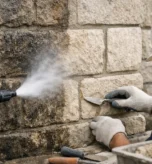
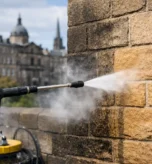
Stone cleaning also deserves care. Aggressive cleaning can remove the protective weathered surface of sandstone and expose a softer layer beneath. The right method depends on the type of soiling, condition of the stone and the desired outcome. Cleaning should never be treated as a separate cosmetic task when the masonry itself is vulnerable.
Plan for maintenance after the restoration
A well-executed repair gives a building a stronger future, but stonework still needs observation. Check gutters, downpipes and flashings regularly, especially after severe weather. Water running repeatedly down a façade can cause far more harm than gradual age-related weathering.
Keep an eye on mortar joints around chimneys, parapets, window surrounds and other exposed features. Early intervention is usually less extensive than waiting until a joint failure has led to loose stone or moisture ingress. Photographs taken every year or two can be useful for tracking whether a crack or area of erosion is changing.
At A & M Sandstone Restoration Edinburgh, the focus is on understanding the condition of the masonry first, then using traditional skills and compatible materials to carry out a repair that respects the building. That approach is especially valuable where Edinburgh’s original sandstone details are worth preserving, not covering over.
The right stonemason should leave you with more than a smarter-looking elevation. You should have confidence that the repair has addressed the cause of deterioration, preserved the character of the property and given its stonework the best possible chance to weather well for years to come.