A great many sandstone repairs in Edinburgh start with the same problem: the joints look tired, someone reaches for a hard cement mix, and a few winters later the stone faces begin to break away. That is why lime mortar versus cement pointing is not a minor technical detail. It often determines whether a repair protects a period building or slowly damages it.
For owners of older sandstone properties, the mortar between the stones should never be treated as filler. Pointing is part of the building’s moisture management, its flexibility, and its visual character. Get it right and the wall can continue to weather as intended. Get it wrong and the mortar may outlast the stone around it for all the wrong reasons.
Why lime mortar versus cement pointing matters
Traditional sandstone buildings were generally designed to work with softer, more breathable materials. Lime mortar allows moisture to evaporate through the joints, and it accommodates slight movement in the masonry. That matters in exposed Scottish conditions, where wind-driven rain, repeated wetting and drying, and freeze-thaw cycles all put pressure on the building fabric.
Cement pointing behaves very differently. It is typically harder, denser, and less permeable than lime. On a modern cavity wall built with harder materials, that may be appropriate. On an older solid-walled sandstone building, it can trap moisture within the stone and force natural movement into the masonry units themselves rather than the joints.
This is the central issue. Mortar should usually be sacrificial. In other words, it should weather before the stone does, because mortar can be renewed far more safely and economically than historic sandstone.
How lime mortar works on historic stonework
Lime mortar is valued in conservation work because it is compatible with traditional masonry. It remains comparatively flexible, which helps it absorb slight seasonal movement and settlement. It is also vapour permeable, allowing moisture to escape rather than remain trapped behind a hard external skin.
For Edinburgh sandstone, that compatibility is especially important. The city’s tenements, villas, boundary walls and period commercial buildings often rely on breathable construction. When the joints are pointed with an appropriate lime mortar, the wall can release moisture in a controlled way. That reduces the likelihood of damp being concentrated in the stone itself.
There is also a visual benefit. Lime pointing can be matched more sympathetically to the age, colour and texture of the building. The finish tends to sit more naturally with dressed sandstone than stark, ribbon-hard cement joints.
What cement pointing does differently
Cement is often chosen because it appears strong and low maintenance. In the short term, it can make masonry look tidy and firm. That surface impression is exactly why it has been used so widely in inappropriate repairs over the last century.
The difficulty is that strength alone is not the right measure for older masonry. If the pointing is harder than the surrounding stone, moisture and stress are redirected into the masonry. Over time this can lead to edge erosion, spalling faces, trapped damp and accelerated decay.
On exposed elevations, cement can also crack away from the arrises of the stone because it does not accommodate movement in the same way as lime. Water then enters through small gaps but cannot evaporate as readily, which makes the problem worse rather than better.
There are cases where cement mortar has a place, but period sandstone buildings are rarely where it performs best. Repair decisions should be based on compatibility, not just hardness.
Lime mortar versus cement pointing in real building terms
For most owners, the real question is not chemistry. It is what happens to the building over ten or twenty years.
With suitable lime pointing, joints may weather gradually and require periodic maintenance. That is normal. It is part of a repair philosophy that protects the masonry units first. The mortar does its job, ages honestly, and can be renewed without forcing the loss of original stone.
With inappropriate cement pointing, the mortar may appear durable while the stone begins to fail beside it. You might see corners breaking off, surface delamination, persistent damp patches, salts, or internal moisture issues. By the time those symptoms are obvious, the repair is often no longer a simple repointing job. It may involve stone repair or replacement as well.
That is why a cheaper or quicker specification can become the more expensive route. What looks durable on day one can compromise the surrounding fabric year after year.
Signs your sandstone building may have the wrong pointing
If a sandstone property has been repaired at different times, it is common to find a patchwork of materials across one elevation. Some joints may be open and friable, while others are packed with dense cement. The warning signs are usually visible if you know what to look for.
Hard, dark grey joints that sit proud of the stone are one clue. Another is stone decay concentrated around otherwise intact mortar. If the face of the sandstone is flaking, blistering or breaking away while the joints remain exceptionally hard, the mortar may be too strong for the wall.
You may also notice damp lingering internally, especially on solid-walled buildings where breathability matters. That does not always mean the pointing is solely to blame, but impermeable repairs can certainly contribute.
Choosing the right mortar is not one-size-fits-all
Although lime is generally the correct approach for historic sandstone, there is still more than one kind of lime mortar. The mix, aggregate, colour, joint profile and exposure level all need to be considered carefully.
A sheltered rear wall may not need exactly the same specification as a highly exposed front elevation. The age and condition of the sandstone matter too. So does the depth of the joints, previous repair history, and whether there are associated defects such as cracks or failing stone indents.
This is where specialist assessment matters. Good repointing is not simply a matter of raking out and refilling joints. The wrong removal method can damage the stone arrises, and the wrong mortar choice can lock in future problems. Heritage-sensitive work starts with understanding how the building was meant to perform.
The appearance of the pointing matters as well
Owners of period properties are often understandably focused on performance, but appearance should not be treated as an afterthought. Mortar joints contribute significantly to the overall character of sandstone masonry. Poorly matched pointing can make a fine elevation look flat, harsh or visibly patched.
Lime mortar allows for a more considered finish in keeping with traditional stonework. Texture, tone and joint line can be adjusted to suit the building rather than imposed in a standardised way. On listed and architecturally significant properties, that level of care is part of proper conservation, not cosmetic fussiness.
Across areas such as New Town, Stockbridge and The Grange, these details have a direct bearing on how well repair work sits with the original fabric. A thoughtful finish preserves the building’s character while supporting its long-term condition.
When cement removal becomes necessary
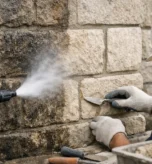
If cement pointing is already causing harm, removal may be the right course of action. That work has to be carried out with care. Aggressive cutting-out methods can do more damage than the cement itself, especially where the stone edges are already weakened.
The process should be controlled, selective and suited to the masonry. Once damaging cement is removed, joints can be repointed in an appropriate lime mortar, and any affected stone can be assessed for repair. In some cases, localised intervention is enough. In others, the extent of trapped moisture and stone decay means a broader restoration programme is needed.
Either way, the aim is not simply to replace one mortar with another. It is to restore compatibility to the wall so that moisture, movement and weathering are managed properly again.
Making the right decision for your building
For most historic and period sandstone properties, lime is not the softer option in the casual sense. It is the technically appropriate one. It respects the way traditional masonry works, protects the surrounding stone, and supports more durable long-term preservation.
Cement pointing can seem neat, solid and reassuring at first glance, but on older sandstone it often creates hidden costs. The question is less whether cement feels stronger and more whether it is too strong for the building it is being asked to serve.
If your mortar joints are failing, or if previous cement repairs are starting to coincide with stone damage, it is worth having the masonry assessed by a specialist who understands traditional sandstone construction. A & M Sandstone Restoration Edinburgh regularly advises on lime pointing and compatible masonry repairs for period buildings, with the focus always on preserving original character as well as structural performance.
The safest repair is usually the one that works with the building rather than against it – and older sandstone nearly always tells you that in time.