A crumbling mortar joint rarely looks urgent at first. On a sandstone building, though, failed pointing can quietly lead to water ingress, loose stone edges, internal damp and avoidable decay. That is why property owners often ask what is lime pointing, and whether it matters for the long-term health of an older building. In most period and historic masonry, it matters a great deal.
What is lime pointing?
Lime pointing is the process of filling and finishing the joints between stone or brick using a lime-based mortar rather than a hard cement mix. The mortar is pressed into the open joints after defective material has been carefully removed, then finished to suit the building, the stone and the exposure of the elevation.
On older sandstone properties, the pointing does more than tidy the appearance. It helps bind the masonry, sheds water from the face of the wall and allows the structure to breathe. That breathing quality is one of the main reasons lime remains the correct material for many traditional buildings.
In Edinburgh, where so much of the city’s character depends on sandstone tenements, villas and listed buildings, lime pointing is not a specialist extra. It is often the appropriate repair method for preserving the masonry properly.
Why lime is used instead of cement
Older buildings were usually constructed with softer, more porous materials than modern masonry. Natural stone and traditional mortars are designed to accommodate slight movement and to manage moisture by evaporation. Lime mortar supports that process. Cement often works against it.
A hard cement pointing mix can trap moisture in the wall. Once water is held in the stone rather than escaping through the joint, the face of the sandstone becomes more vulnerable to erosion, frost damage and spalling. In other words, the mortar may stay put while the stone around it begins to fail. That is the wrong way round.
Lime mortar is deliberately more breathable and more flexible. It allows moisture to evaporate through the joints and it accommodates modest thermal movement without forcing stress into the stone. It is also sacrificial, which is exactly what good pointing should be. Over time, the mortar should weather before the masonry units do.
That trade-off is important. Lime pointing may need maintenance earlier than a very hard cement repair, but it helps preserve the original stonework for longer. For a heritage property, that is usually the better outcome.
How lime pointing works in practice
Good lime pointing starts well before fresh mortar goes into the wall. The existing joints need to be assessed properly first. Some mortar may only be weathered at the surface, while some joints may be deeply recessed, fractured or contaminated by previous cement repairs.
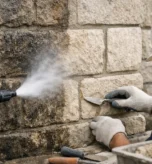
The defective pointing is then raked out with care, avoiding damage to the stone arrises. This stage matters. Heavy-handed removal can scar the masonry and create a larger repair than necessary.
Once the joints are prepared, a suitable lime mortar is selected. The correct mix depends on the age of the building, the type of sandstone, the width and depth of the joints, and how exposed the wall is to weather. There is no single mortar that suits every property. A sheltered elevation in The Grange may not require exactly the same approach as a highly exposed frontage in Portobello or a windswept wall in South Queensferry.
The fresh mortar is then firmly compacted into the joints in layers where needed. After that, it is finished to match the original character of the building as closely as possible. The final profile affects both appearance and performance, so this is not simply a cosmetic decision.
What is lime pointing designed to achieve?
At its best, lime pointing does three jobs at once. It seals open joints against excessive water penetration, it allows trapped moisture to evaporate back out, and it supports the visual character of the masonry.
That balance is especially important on traditional sandstone buildings. If joints are left open, rainwater can enter too easily. If joints are filled with a mortar that is too hard or too dense, moisture can become trapped. Lime sits in the middle ground. It provides protection without suffocating the wall.
It also helps maintain the appearance of period masonry. Poor pointing can flatten the face of a stone wall, smear over the edges of the masonry, or create harsh lines that look visibly wrong on an older elevation. Well-executed lime pointing should look in keeping with the building rather than drawing attention to itself.
Signs your building may need lime pointing
Mortar does not have to be missing completely before repairs are justified. In fact, waiting too long often allows more extensive stone decay to develop.
Common signs include joints that are recessed or powdery, cracks through the mortar, loose fragments falling from the joints, damp patches internally, and localised deterioration to the stone edges. Sometimes the problem is previous cement pointing rather than missing mortar. If the stone face is breaking down while the joints remain unusually hard and intact, the pointing may be contributing to the damage.
On listed and period properties, it is worth having this assessed early. The cost difference between careful repointing and later stone repair can be significant.
What is lime pointing on sandstone meant to look like?
This is where experience matters. The right finish depends on the age, style and construction of the building. Joint width, mortar colour, aggregate choice and finish all affect the final result.
A good repair should sit comfortably within the existing masonry. It should not appear bright, flat or overly neat in a way that jars with historic stonework. Equally, it should not be pushed back too far from the face, as deep recessed joints can hold water and leave the stone edges more exposed.
Matching the character of the original pointing is part of heritage-sensitive repair. On Edinburgh sandstone, small differences in colour and texture can be surprisingly noticeable once scaffold is down and the wall has dried out.
Why lime pointing is especially important in Edinburgh
Edinburgh’s building stock makes lime pointing particularly relevant. Much of the city is built in sandstone, and many properties date from periods when lime mortar was standard practice. Add a wet climate, repeated freeze-thaw cycles and exposure to driving rain, and the condition of mortar joints becomes a serious maintenance issue rather than a minor visual one.
Older tenements and villas in areas such as New Town, Stockbridge, Bruntsfield and Morningside often show the same pattern. Cement repairs have been introduced over time, moisture becomes trapped, and the stone begins to break down around the joints. Correcting that usually means removing incompatible repairs and reinstating a suitable lime mortar with care.
For owners who want to protect both value and fabric, this is not about chasing a heritage ideal for its own sake. It is about using materials that work with the building rather than against it.
Is lime pointing always the right choice?
Often, but not automatically. The correct specification depends on the building and its condition. Some walls have mixed repair histories. Some have severe exposure. Some may need associated stone indents, crack repairs or localised replacement before repointing can begin.
There is also more than one type of lime mortar. The strength and composition should be chosen to suit the masonry. A mortar that is too weak may wash out prematurely in exposed conditions, while one that is too strong can create avoidable stress in softer stone. This is why proper assessment matters more than applying a generic rule.
For that reason, lime pointing should be treated as part of a wider masonry repair strategy, not as a standalone product. On a well-maintained building, it protects the envelope. On a neglected one, it may be one element of a broader restoration programme.
Choosing a specialist for lime pointing
Lime pointing is straightforward to describe, but it is easy to get wrong. Poor joint preparation, inappropriate mortar selection and rushed finishing can all shorten the life of the repair or affect the masonry around it.
On older sandstone buildings, specialist knowledge is worth paying for. The contractor should understand traditional materials, moisture behaviour, stone condition and the visual requirements of heritage work. That is particularly important where listed buildings or architecturally sensitive elevations are concerned.
A & M Sandstone Restoration Edinburgh approaches lime pointing as a conservation-led repair, with attention to compatible materials, careful workmanship and the long-term performance of the building fabric.
If you are looking at weathered joints and wondering whether they are merely untidy or the start of a more serious problem, it is usually wise to act sooner rather than later. Good lime pointing protects more than the joint itself – it helps preserve the stone, the building and the character that made the property worth caring for in the first place.