Sandstone rarely suffers from neglect alone. More often, it is damaged by well-meaning cleaning that is too harsh, too wet, or simply wrong for the age and condition of the stone. If you are looking into how to clean sandstone safely, the first step is understanding that sandstone is not a hard, uniform surface like modern concrete. It is porous, variable, and often far more delicate than it appears, particularly on older Edinburgh buildings.
For period and listed properties, cleaning should never be treated as a cosmetic job in isolation. Surface staining may be the visible issue, but trapped moisture, failing joints, spalling faces, and previous cement repairs often sit behind it. A careful approach protects the stone itself, not just its appearance.
Why sandstone needs a cautious approach
Sandstone is formed from compressed mineral grains, and its durability depends on the type of stone, its bedding, exposure, and previous repairs. Some blocks remain sound for generations. Others soften, flake, or break down after years of weathering. Once the protective outer face is stripped away by aggressive cleaning, deterioration can accelerate quickly.
That is why methods that seem effective in the short term can create long-term problems. Pressure washing may remove dirt fast, but it can also force water deep into the wall, enlarge weak areas, and loosen decayed stone. Acid-based cleaners are another common mistake. They can react badly with adjacent lime mortar, disturb the stone surface, and leave historic masonry more vulnerable than before.
This matters especially across Edinburgh’s older terraces, villas, and tenements, where sandstone elevations have already endured decades of exposure. Cleaning should support preservation, not simply brighten the facade for a few months.
How to clean sandstone safely without causing damage
The safest cleaning method is usually the gentlest one that will do the job. In many cases, that means starting with a close inspection, light dry brushing, and controlled washing with clean water rather than jumping to chemicals or mechanical cleaning.
Begin by identifying what is actually on the stone. General grime, algae, carbon staining, paint, efflorescence, and rust marks do not respond in the same way, and they should not be treated as if they do. A blackened urban facade may need a very different approach from green biological growth on a damp garden wall.
Before any wider cleaning, test a small, discreet area. This reveals how the stone reacts, whether the stain is superficial, and whether the chosen method leaves the surface unchanged. If cleaning exposes friable stone, hidden delamination, or open joints, stop there. The issue is no longer cleaning alone.
For light surface dirt, a soft natural bristle brush and clean water are often enough. Work gently, keep the area controlled, and avoid saturating the wall. Sandstone should never be scrubbed with wire brushes or abrasive pads, as these can score the face and remove the weathered surface that helps protect the stone.
If water is used, it should be used sparingly. Over-wetting porous masonry can drive moisture inward, particularly where mortar joints are cracked or cement pointing has trapped moisture within the wall. This is one reason older sandstone often needs a masonry assessment before cleaning begins.
Cleaning methods to avoid on sandstone
There are a few methods we would always approach with extreme caution, and in many cases avoid altogether.
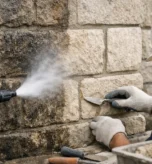
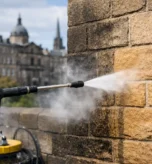
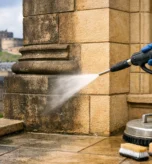
High-pressure washing is one of the most damaging. Even when the stone looks solid, pressure can open the grain, wash out softer areas, and erode mortar joints. On historic sandstone, the damage is not always obvious straight away. It may appear later as surface loss, accelerated weathering, or localised spalling.
Harsh chemical cleaners are another risk. Strong acids and bleach-based products can alter the stone, affect surrounding materials, and create uneven results. They may also leave residues behind, which continue to react after the initial clean. What starts as stain removal can become irreversible surface damage.
Abrasive blasting should also never be treated as a routine cleaning solution. Used incorrectly, it strips the face of the stone and leaves it exposed to faster decay. Specialist low-impact systems do exist, but they belong in the hands of experienced stone restoration professionals who understand both the material and the building.
When staining points to a deeper problem
Not every dirty-looking wall simply needs cleaning. Sometimes discolouration is a symptom rather than the main issue.
Green staining often suggests persistent damp conditions. Black crusting in exposed city locations may indicate long-term pollution build-up. White salts can point to moisture movement through the wall. Rust staining may come from failed metal fixings or embedded ferrous elements. If the cause is not addressed, the staining is likely to return no matter how carefully the stone is cleaned.
This is where experience matters. On older sandstone buildings, particularly where repairs have been carried out over many years, cleaning can uncover failing lime joints, inappropriate cement pointing, or stones that have decayed beneath a hardened surface skin. A building that looks as though it needs a wash may in fact need repointing, localised stone repair, or selective stone replacement.
The role of mortar joints in safe sandstone cleaning
Mortar joints are often overlooked during cleaning, yet they are central to how the wall performs. Traditional sandstone buildings were typically built with lime mortar, which allows the structure to breathe and accommodates slight movement. Where lime has eroded or been replaced with hard cement, moisture behaviour changes, and cleaning becomes more risky.
If joints are open, cracked, or friable, washing the wall can introduce water where it should not go. If cement pointing is present, moisture may become trapped in the stone instead of evaporating through the joints. That can increase the likelihood of face loss and spalling during colder weather.
For that reason, safe cleaning is often tied to wider maintenance. A stone facade in good condition can usually be cleaned more predictably than one with failed pointing and active water ingress. Treating the building fabric as a whole generally gives a better and longer-lasting result.
How to clean sandstone safely on listed and period properties
On listed buildings and period homes, the threshold for caution is even higher. Original stone tooling, aged surface character, and historic mortar details all have value. Cleaning should preserve those features, not erase them.
This does not mean sandstone must be left dirty indefinitely. It means the method has to suit the building. Sometimes the right decision is a very light clean. Sometimes it is selective cleaning to the most affected areas only. And sometimes it is no cleaning at all until repairs are completed first.
Owners of properties in areas such as New Town, Stockbridge, Morningside, and The Grange are often dealing with masonry that is both visually prominent and architecturally sensitive. A poor cleaning decision on a front elevation can alter the appearance of the stonework far more than expected, especially where one area is cleaned unevenly against weathered surrounding masonry.
When to bring in a sandstone specialist
If the stone is flaking, powdering, cracking, or showing signs of spalling, cleaning should not be attempted as a standalone job. The same applies if staining keeps returning, mortar is failing, or the building has patch repairs in cement or modern fillers. In those cases, a specialist assessment is the sensible route.
A skilled sandstone restoration contractor will look at more than the stain itself. They will consider stone type, exposure, previous interventions, moisture movement, mortar compatibility, and whether the wall needs repair before any cleaning is carried out. That is particularly important on older Edinburgh properties, where preservation-first methods are essential if the original masonry is to be protected properly.
At A & M Sandstone Restoration Edinburgh, that principle sits at the centre of the work. Cleaning should support the life of the stone, not shorten it.
Practical advice for day-to-day care
For routine upkeep, restraint is usually the best policy. Keep vegetation from taking hold against the wall, ensure gutters and downpipes are working properly, and deal with small mortar defects before they allow water into the masonry. Those simple measures often do more for sandstone than frequent cleaning.
If you do clean a small area yourself, use the mildest method available, work on a test patch first, and stop if the stone softens, sheds grains, or changes colour unevenly. What sandstone tolerates on one property may be entirely unsuitable on another.
Well-kept sandstone does not need to look newly quarried. A degree of age and weathering is part of its character. The aim is not to strip history away. It is to care for the stone in a way that respects the building, preserves its detail, and avoids turning a manageable maintenance task into a much larger restoration problem.
If there is any doubt, the safest cleaning decision is often to ask for experienced advice before the first bucket of water is lifted.